Marie - Helene H.
Très beau jouet

Ricerche di tendenza
Cerca per budget
1 tocco per filtrarePer fascia d'età
Selezione rapida
Nessun giocattolo trovato
Non abbiamo trovato risultati per questa combinazione. Prova con una parola chiave più breve o con un altro filtro di budget.
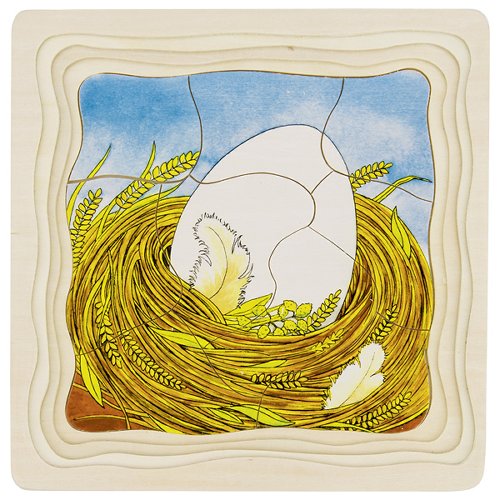
Vedi i 600+ giocattoli del catalogo →This chicken life cycle puzzle stacks four wooden layers: the egg in its nest, the hatching, the chick, then the hen. Lifting the layers out one by one, your child follows the animal as it grows, in the right order. By Goki, from 3 years.
Rif. : REFG57521
The puzzle opens on a large white egg resting in a nest of straw, between ears of wheat and two downy feathers. Your child lifts out the pieces of this first picture and sets them beside the frame. Underneath, the shell has cracked and a yellow chick is poking its beak out. One more layer, and the chick is standing in the grass among daisies. At the very bottom, the white hen with her grey-speckled neck sits on her eggs among buttercups.
The hen is now sitting on eggs of her own, so the story can start all over again. The life cycle puzzle is then rebuilt the other way round, from the hen back up to the egg, each picture put together on top of the one before it.
Each layer isolates a single stage. Your child does not have to take in the whole of growing up in one go: first an egg, then an egg that opens, then a small animal, then an adult bird. Putting these pictures in order and saying what comes before and what comes after gives an early sense of time that can be touched with the fingers. The words follow as the pieces come out: nest, shell, hatch, sit on eggs. Told like this, the life cycle of a chicken stops being something adults explain and becomes four pictures your child handles.
With 44 pieces spread over four pictures, the puzzle also asks for precision: picking a piece up by its edge, turning it until it slots in, then laying a finished layer back down without disturbing the one beneath. The educational side stays simple and concrete: a living thing hatches, grows, then lays eggs in turn, and your child watches it happen layer by layer.
Open the puzzle yourself the first time, slowly, naming each stage as it appears: the egg, the hatching, the chick, the hen. Then let your child remove a single layer and rebuild it before moving on to the next one. The usual mistake is to tip everything onto the table straight away. The pieces get mixed up, and a scrap of straw or sky could belong to three different pictures.
Each piece fits only its own cut-out, and the frame is cut in wavy steps that give every layer its own ledge, so your child can see without being told when a piece is in the wrong place. This self-correction is what the Montessori approach calls control of error, and it lets a child try again without waiting for an adult.
When the order is secure, put an egg from the kitchen next to the puzzle and compare the two: the shell, its shape, what is inside it.
At 3, most children happily take the layers apart and put them back with a little help, one layer at a time. Later, they rebuild all four pictures unaided and start to explain what goes on inside the egg before it hatches. That is when a life cycle puzzle earns its place on the shelf: the same four pictures serve first for naming, then for telling the whole story from egg to chicken. Our children's farm toys carry the theme on with other farmyard animals.
A slightly damp cloth is all the wooden pieces need; do not leave them to soak, as wood takes badly to water. Store the puzzle assembled in its frame: it is the surest way not to lose a piece.
A classic jigsaw shows a single scene. This wooden layered puzzle tells a transformation, in a 20 x 20 x 1.5 cm format that fits on a small table. The illustrations stay close to real life: a white hen with a red comb, a fluffy chick, straw and wild flowers. Goki uses the same principle with other animals, such as the caterpillar that turns into a butterfly, drawn in a softer style; the chicken life cycle puzzle is the more realistic of the two.
For other shapes to fit together, see our puzzles and tangrams, and our traditional wooden toys cover more classic play in the same material.
Goki recommends it from 3 years. At that age, start with one or two layers; all four come a little later.
From the top of the frame to the bottom: the egg in the nest, the hatching, the chick in the grass, then the hen sitting on her eggs. Taking the puzzle apart therefore follows the chicken's life in the order it really happens.
There are 44 wooden pieces across four stacked layers. Goki gives its size as 20 x 20 x 1.5 cm.
3+
Legno Naturale Durevole
Certificato CE e EN 71, vernici e cere all'acqua atossiche
Nuovo (Confezione originale)
Pulire con un panno morbido leggermente inumidito con acqua tiepida. Non immergere mai né usare detergenti aggressivi.
Per preservare la lucentezza del legno grezzo nel tempo, applicare una goccia di olio vegetale o cera d’api 1 volta all’anno.
Questo giocattolo non ha ancora ricevuto recensioni individuali. Scopri i riscontri certificati di altre famiglie sulle nostre creazioni.
Très beau jouet
Beau jouet mais la tête du clown rentre entièrement dans la bouche de mon petit fils (12mois) …. Ce qui ne me rassure pas !
Envoi rapide, produits conformes à la description.
Rapide, efficace et jeux top!
Astucieux ! Compris l'heure en un rien de temps, la mémoire a fait le reste. Ludique +++
Génial !
Altri materiali sensoriali pensati per questa fase di crescita.
 3-6 anni
-15%
3-6 anni
-15%