Marie - Helene H.
Très beau jouet

Ricerche di tendenza
Cerca per budget
1 tocco per filtrarePer fascia d'età
Selezione rapida
Nessun giocattolo trovato
Non abbiamo trovato risultati per questa combinazione. Prova con una parola chiave più breve o con un altro filtro di budget.
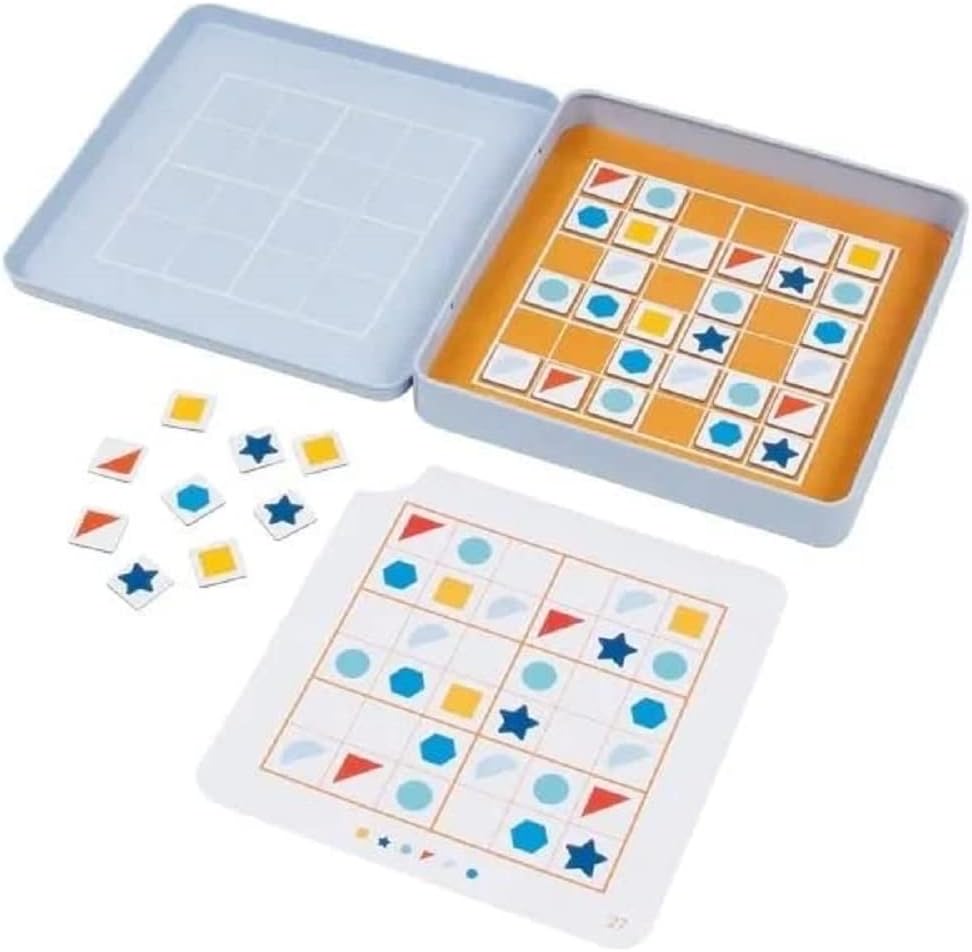
Vedi i 600+ giocattoli del catalogo →A sudoku for kids that swaps numbers for six coloured shapes. From 6 years, your child copies one of 25 pattern cards onto the grids of a hinged metal tin, then completes it with 36 magnetic pieces: a magnetic travel game for one player.
Rif. : REFG56656
Your child opens the metal tin flat, like a book. The light blue lid holds a small four-by-four grid; the orange base holds a larger six-by-six one. They choose a pattern card, find the shapes already printed on it and place the matching magnetic pieces on the same squares of the grid. What is left is the real puzzle: the empty squares.
The rule fits in one sentence: each shape appears only once in every row, every column and every block. Each small white piece carries one shape – a navy star, a red triangle, a yellow square, a light blue circle, a turquoise hexagon or a grey-blue semicircle. To work out where the star goes, your child runs a finger along the row, then down the column, then around the block, and rules out the forbidden squares one by one.
Nobody has to take turns or wait for a partner. This is a single-player travel game as much as a puzzle for a quiet corner at home: the child picks a card, solves it at their own pace, and decides alone whether to try another.
The first thing it trains is logic. Placing a shape means reasoning by elimination: "the yellow square is already in this row and in this block, so it can only go here." Children learn to hold several conditions in mind at once and to check before they put a piece down, rather than guess. Because shapes replace digits, a sudoku for kids of six does not ask them to be comfortable with numbers yet: the work is comparing and spotting, not counting. That makes it an educational game where the learning sits in the hands, with no worksheet in sight.
The second is attention. The large grid asks the eye to sweep an entire row without skipping a square, then do the same in the other direction. The set also builds in what the Montessori approach calls control of error: two red triangles in the same column jump out, and it is the child who notices them and moves the wrong piece, without an adult stepping in to correct.
For the very first game, choose a four-by-four sudoku for kids, which uses only four shapes. Place the printed pieces together, then fill one row while thinking out loud: "The circle is missing here, because I already have the star, the square and the triangle." Then hand over and let your child finish the grid.
The most common mistake is placing a shape because it "looks right" without checking the block. Show the checking gesture: one finger on the row, one on the column, a glance at the block. If a grid resists for too long, put it aside and pick another card rather than giving away the answer; an easy sudoku for kids only stays easy when the grid size matches the child.
Once your child has the hang of it, change the routine: they set up the grid from the card alone, turn the card face down and solve without looking at it again. Remembering which pieces were printed adds a new layer without changing the rule.
At 6, the small grid is often enough: it explains the rule without discouraging anyone. Around 7, the large grid takes over, and a six-by-six sudoku for kids is a genuine step up, since juggling six shapes instead of four changes the difficulty noticeably. At 8, the big format still holds interest with a fresh goal: finishing a grid without moving a single piece. Later, the move to number and logic puzzles on paper comes naturally, because the reasoning is identical and only the symbols change.
Looking after it is simple. Wipe the metal tin with a dry cloth and keep it away from water, which neither metal nor card likes. Put the pieces in the base and the cards on top before closing the lid: the whole game stays together in one place, ready for the next journey.
What sets this box apart is its format: a square tin measuring 16.2 x 16.2 x 2.6 cm that is both board and storage. The pieces are magnetic and sit on the metal instead of sliding about like loose counters, so this magnetic sudoku copes with the car, the train or a waiting room, and rests on a lap. Among magnetic travel games, it is one for a single player, for the moments when a child wants something calm to do. Think of it as a travel brain game that slips into a bag.
Compared with a sudoku board game on a large board, it leaves nothing lying around; compared with a paper puzzle book, there is nothing to rub out – you simply move the piece. It works on a tray table too, which makes it a practical choice among travel games for the plane, and a quiet alternative to the car games for travelling that rely on talking. You will find it among our logic games, alongside other puzzles for children who like to think quietly; for more ideas at the same age, have a look at our toys for 6 year olds and up.
This set is recommended from 6 years. Shapes take the place of numbers, and the four-by-four grid in the lid lets children discover the rule before tackling the larger one in the base.
With shapes, a child does not mistake sudoku for a sum: they compare symbols and add nothing up. The logic is the same as in a number grid, which makes the later switch to digits easier.
The pieces are magnetic and the tin is metal, so they hold on the grid far better than loose counters would. A half-finished puzzle can be played on a lap in the back seat or on a train table.
It comes with 25 pattern cards, with grids of four by four and six by six, plus 36 magnetic pieces: 61 pieces in all.
6+
Carta Spessa ad Alta Tenuta
Certificato CE e EN 71, vernici e cere all'acqua atossiche
Nuovo (Confezione originale)
Spolverare con un panno asciutto. Conservare al riparo da umidità e luce solare diretta prolungata.
Riporre in verticale o in orizzontale su uno scaffale basso ad altezza di bambino secondo i principi Montessori.
Questo giocattolo non ha ancora ricevuto recensioni individuali. Scopri i riscontri certificati di altre famiglie sulle nostre creazioni.
Très beau jouet
Beau jouet mais la tête du clown rentre entièrement dans la bouche de mon petit fils (12mois) …. Ce qui ne me rassure pas !
Envoi rapide, produits conformes à la description.
Rapide, efficace et jeux top!
Astucieux ! Compris l'heure en un rien de temps, la mémoire a fait le reste. Ludique +++
Génial !
Altri materiali sensoriali pensati per questa fase di crescita.