Marie - Helene H.
Très beau jouet

Ricerche di tendenza
Cerca per budget
1 tocco per filtrarePer fascia d'età
Selezione rapida
Nessun giocattolo trovato
Non abbiamo trovato risultati per questa combinazione. Prova con una parola chiave più breve o con un altro filtro di budget.
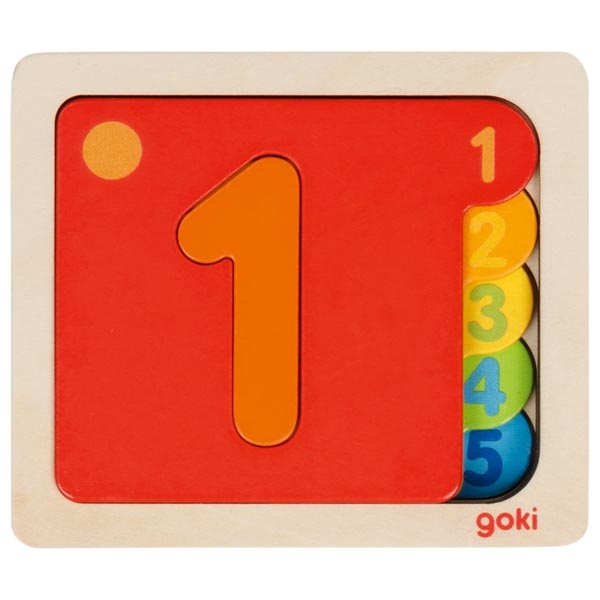
Vedi i 600+ giocattoli del catalogo →This wooden number puzzle stacks five coloured layers, one for each number from 1 to 5. Your child lifts out each numeral, counts the dots beside it and rebuilds the layers in order: a wooden layered puzzle by Goki for a first step into numbers, from 2 years.
Rif. : REFG57410
The puzzle opens on a red layer with an orange 1 set into its centre. Your child picks the numeral out, puts it to one side, then lifts the red layer away: underneath sits an orange layer holding a yellow 2. The same gesture carries on, layer after layer, down to the light-blue 5 at the bottom of the frame. Along the right-hand edge, a notch shows the numbered tab of every layer, each one stepped slightly below the last, so the whole sequence can be read at a glance before anything is moved.
Then the wooden number puzzle works in reverse. Everything goes back, from 5 up to 1, each numeral into its own cut-out and each layer onto the one beneath. There are ten pieces in all, five layers and five numerals, which is few enough for a young child to keep track of every piece on the table.
On the left side of each layer, coloured dots give the value of the number: one dot on the layer of the 1, two on the layer of the 2, and five lined up in a column on the layer of the 5. Your child touches the dots one at a time while counting aloud, then runs a finger round the outline of the numeral. Reciting "one, two, three" is not yet counting: a child has to grasp that 3 means three things. Because the symbol and the quantity sit on the same layer, the puzzle becomes a small matching numeral to quantity game rather than a list to learn by heart.
Number recognition grows out of that back-and-forth between hand and voice: first the shape of the 4, then the four dots that confirm it. It is an educational puzzle in the plainest sense, with nothing on it that does not serve the number.
The hands work too. Picking a numeral out by its cut-out, lifting one layer without shifting the ones underneath, then laying it back flat in the frame all ask for careful, controlled finger movements.
Open the puzzle in front of your child, naming each number as it appears, then hand it over and let them retrace the path. The mistake to avoid is tipping all ten pieces onto the table at the first go: that is a lot for a two-year-old. Begin with the numerals alone, taking them out and pressing them back into their layer, without taking the layers apart.
A layer put back in the wrong place stops the puzzle from closing, so the material itself shows the mistake and no adult has to point it out. The Montessori approach calls this control of error, and it is what lets a child try again calmly instead of waiting to be told.
Once the sequence is secure, hide one numeral and ask which one is missing, or ask your child to fetch as many spoons as there are dots on a layer. Short number recognition activities like these slip into the day, at the table or while tidying up, and need no worksheet.
At the start, your child mostly explores the gesture and hears the names of the numbers. Later, they count the dots by themselves and announce the number before lifting it out. By 3 or 4, the wooden number puzzle turns into a quick check: you can see straight away whether the 4 is recognised without the dots being counted again. Among Montessori maths activities for 2-year-olds, it is one that still has a job to do a year later, when counting has taken over from naming. When your child wants bigger quantities, our counting toys take over where the five layers stop.
Wipe the wood with a barely damp cloth and let it dry in the open air; never soak it, as water does wood no favours. After each session, put the puzzle away closed, every numeral in its place, so that nothing goes missing between two sessions.
On a flat tray, a child can put the numbers down in any order. Here the layers impose the sequence from 1 to 5, and each layer gathers three signs of the same number: the cut-out numeral, the dots and the numbered tab. Many learn to count toys show quantities alone; this wooden layered puzzle also puts the written numeral in the child's hand, as a piece to lift out and fit back.
At 12.7 x 11 x 2.4 cm, this wooden counting toy takes up little room on a shelf and comes out quickly for a five-minute session. The wooden number puzzle stops at five, which is enough for a first encounter with numbers. For numbers beyond 5, browse our number puzzles, and our puzzles and tangrams offer other shapes to fit together.
Goki recommends it from 2 years. At that age, name the numbers while your child lifts the layers; counting the dots comes a little later.
Name the numeral, have your child count its dots, then ask them to find the same numeral among the ones laid out on the table. The colour of each layer helps at first, then the shape of the numeral takes over.
There are ten pieces: five layers and five removable numerals, held in a wooden frame. Goki gives its size as 12.7 x 11 x 2.4 cm.
2+
Legno Naturale Durevole
Certificato CE e EN 71, vernici e cere all'acqua atossiche
Nuovo (Confezione originale)
Pulire con un panno morbido leggermente inumidito con acqua tiepida. Non immergere mai né usare detergenti aggressivi.
Per preservare la lucentezza del legno grezzo nel tempo, applicare una goccia di olio vegetale o cera d’api 1 volta all’anno.
Questo giocattolo non ha ancora ricevuto recensioni individuali. Scopri i riscontri certificati di altre famiglie sulle nostre creazioni.
Très beau jouet
Beau jouet mais la tête du clown rentre entièrement dans la bouche de mon petit fils (12mois) …. Ce qui ne me rassure pas !
Envoi rapide, produits conformes à la description.
Rapide, efficace et jeux top!
Astucieux ! Compris l'heure en un rien de temps, la mémoire a fait le reste. Ludique +++
Génial !
Altri materiali sensoriali pensati per questa fase di crescita.